
Q2 2026 - Energy Security Takes the Driver's Seat


If Q1 was about the shock of an energy crisis, Q2 has been about the response to one. Governments, corporates, and consumers alike spent the quarter putting energy security firmly in the driver's seat — from EU’s new strategy to insulate itself from fossil fuel dependence, to a fresh wave of Indian battery storage and EV infrastructure, to a global EV buying spree that shows no signs of slowing. Europe's carbon border tax also got its first real price tag, adding a new cost dimension for exporters into the bloc, while investors continued to size up energy security and climate adaptation as the next big theme.
As always, we've linked the sources at relevant places for you to dive deeper into anything that catches your eye. Do drop us your thoughts in the comments or at info@esgityadvisors.com.
GLOBAL UPDATES
Microsoft's Carbon Removal Pause Rattles the Market

Microsoft has communicated to its suppliers that it is pausing future purchase of carbon removal credits while it reassesses its portfolio of credits. The move has unsettled early-stage carbon removal developers, even as the company maintains it isn't halting purchases indefinitely and that existing multi-year contracts remain intact.
Microsoft was responsible for nearly 90% of all durable carbon removal credit purchases last year alone, having signed deals with 21 companies globally in FY2025 to remove a record 45 million tonnes of CO2, including contracts with Re.green (Amazon reforestation), Vaulted (biochar burial), and, as recently as March 2026, Liferaft, a Midwest agricultural-waste biochar developer. A company spokesperson said that Microsoft continually reviews its carbon removal portfolio alongside market conditions to find the right balance on its path to carbon negativity. The pause also comes at a lean funding moment for the sector where the US Energy Department has cancelled funding for multiple carbon removal projects.
Europe's Carbon Border Tax Gets Its First Price Tag

The EU's Carbon Border Adjustment Mechanism (CBAM), the world's first emissions tariff, began applying its pricing mechanism this year. Europe's Taxation and Customs Union released the first CBAM certificate price for Q1 2026 at € 75.36 per metric tonne of CO2 equivalent, based on average auction prices in the EU Emissions Trading System. Prices will be published quarterly through 2026 before moving to a weekly cadence from 2027.
CBAM's definitive regime covers six sectors - cement, iron and steel, aluminium, fertilisers, electricity, and hydrogen. Importers must now purchase and surrender certificates for embedded emissions, with the first certificate sales on the EU's central platform opening from February 1, 2027. This early publication of price aims to enhance transparency, provide stakeholders with timely information, and reduce the risk of inconsistent or unofficial price estimates circulating in the market.
The UK Drafts Its Own CBAM

Image Source: Blog In2English The UK released draft regulations for its own carbon border tax, expected to apply from January 1, 2027. Designed to be interoperable with the EU's mechanism, the UK's CBAM will cover the same product categories at a broadly similar cost. The draft sets out how embodied emissions will be calculated and verified.
The UK version covers five sectors — aluminium, cement, fertilisers, hydrogen, and iron and steel — notably excluding electricity and, unlike the EU regime, leaving out glass and ceramics. Inclusion of indirect (electricity-related) emissions has been pushed back to 2029 to preserve support under the UK's Energy Intensive Industries Compensation Scheme for carbon intensive sectors. Further, only explicit carbon prices determined through emissions trading systems or fixed carbon taxes and not fuel duties will be recognised for calculating relief, where a third country has already priced carbon.
EU Launches ‘AccelerateEU’ to Tackle Energy Costs
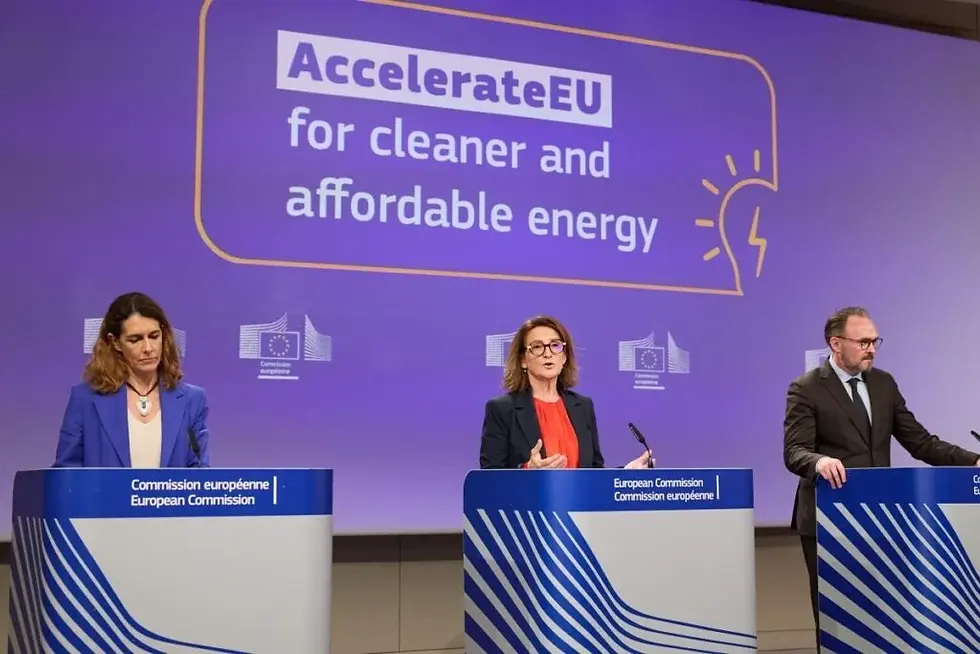
Image Source: Energy_Storage.news The European Commission launched AccelerateEU, a strategy to counter rising energy costs and cut dependence on imported fossil fuels, which have already cost the bloc an extra € 24 billion amid recent geopolitical tensions. AccelerateEU was triggered directly by the Middle East conflict and the closure of the Strait of Hormuz, against a backdrop where 57% of the energy the EU consumes is still imported fossil fuel, costing the bloc € 340 billion in 2025 alone. The plan targets expanding energy storage capacity from 55 GW to 200 GW by 2030, doubling annual heat pump deployment, and rolling out smart meters to at least half of consumers by 2031. This is combined with near-term relief like subsidies, energy vouchers, tax adjustments, and a new Fuel Observatory to monitor energy supply. It also introduces structural measures to scale homegrown clean energy through electrification, grid expansion, and faster renewables deployment.
Backed by € 219 billion in EU funds and aiming to mobilise up to € 660 billion a year in investment, the strategy frames the energy transition as both an economic and security imperative. European Commission President Ursula von der Leyen said that the bloc must accelerate its shift to homegrown clean energy to secure independence and weather geopolitical shocks. The Commission has also proposed a € 100 billion Industrial Decarbonisation Bank, including a € 30 billion ‘ETS Investment Booster’ financed by 400 million EU ETS allowances, and plans to review the EU Emissions Trading System by July 2026.
INDIA UPDATES
India's Largest EV Battery Swapping Hub Opens at JNPT

Ravindra Energy, through its associate Energy In Motion (EIM), commenced operations at India's largest battery swapping and charging station for heavy EVs at Nhava Sheva (JNPT). The 3 MW automated facility can service over 160 electric heavy vehicles a day and already supports 130-plus EVs deployed at the port — another sign of India Inc.'s shift toward electrified logistics in high-emission sectors like freight and ports.
The facility was developed jointly with Nhava Sheva Freeport Container Terminal (NSFT), a joint venture between France's CMA Terminal Holdings and the J M Baxi Group, with the two partners targeting full electrification of NSFT's vehicle fleet by the end of FY 2026-27. EIM, in which Ravindra Energy holds a 49.5% stake, separately signed a deal in March 2026 to supply 66 of its battery-swappable “Ashwa” e-tractors to Transvolt Mobility for deployment at JNPT and Kandla Port, a move expected to cut roughly 3,300 tonnes of CO2 emissions annually. Ravindra Energy Vice Chairman Narendra Murkumbi said that the model of selling vehicles without battery packs while offering swappable batteries and charging as a service is designed to solve the entire heavy-EV adoption challenge.
Adani Green Commissions World's Largest Battery Storage Project Outside China

Adani Green Energy (AGEL) commissioned a cumulative 3.37 GWh Battery Energy Storage System (BESS) at Khavda, Gujarat — the world's largest single-location battery storage deployment outside China, and one of the fastest built globally, completed within 10 months. The project, capable of powering nearly a million homes for a day, strengthens grid reliability and round-the-clock clean power supply. AGEL plans to add over 10 GWh of storage capacity in FY27 and 50 GWh over the next five years, in support of India's broader decarbonisation goals.
The BESS sits within AGEL's 30 GW Khavda Renewable Energy Park in Gujarat's Kutch district — of which 9.9 GW is already operational — taking the company's total operational portfolio to 19.79 GW, India's largest. AGEL has invested roughly ₹1.5 lakh crore in the Khavda site to date, and industry trackers suggest the storage build-out could scale further still, to around 14 GWh by the end of FY27. The commissioning is timely: India's Central Electricity Authority estimates the country will need about 411.4 GWh of energy storage by 2031-32, yet only around 800 MWh had been deployed nationally as of the end of last year, underlining how much of the buildout still lies ahead.
British International Investment maintains its pro-India stance

Image Source: ESG News British International Investment (BII), which already holds a US$ 2.5 billion India portfolio, plans to maintain India's 25% share of its global investments and is teaming up with domestic pension and insurance funds on major climate projects. New initiatives such as the US$ 300 million North Star renewable platform point to more solar, wind, and storage projects, alongside a broader push to draw in private capital.
North Star will see BII and Copenhagen Infrastructure Partners' Growth Markets Fund II each commit up to US$ 150 million, targeting solar, wind, hybrid, and storage projects expected to generate over 4 million MWh of clean electricity annually and avoid roughly 4 million tonnes of carbon emissions a year. It is the first deployment under BII's newly launched £1.1 billion British Climate Partners programme, which aims to mobilise £3.5 billion of private capital over its lifetime, and comes as India faces an estimated US$ 160 billion annual funding gap to more than triple its renewable capacity by 2030.
SECOTRAL UPDATES
Automobile | Consumers react with a Global EV Buying Spree

Image Source: Bloomberg France, Germany and the UK together sold 206,200 EVs in the month of March alone, a 44% jump over the year-earlier period. South Korea too saw EV transactions more than double, while Italy, where the path to electrification has been slow, saw a 67% increase. Globally, consumers bought 1.1 million EVs in March, with battery-electric models making up 17% of new car sales worldwide. This was driven by elevated fuel prices combined with a flood of affordable Chinese models. Chinese EV and hybrid exports rose 140% year-on-year, driving the surge.
Online searches for EV listings intensified sharply in the weeks after the war began, a pattern BloombergNEF says has historically preceded stronger sales, reinforcing the read that this isn't a one-month blip but a structural shift in how quickly price-shocked consumers are willing to switch away from petrol and diesel.
Pharma | Status of green operations in the Indian pharma industry

Image Source: DoIT ERP Over 80% of Indian pharma companies have now adopted zero liquid discharge systems, according to a recent ICRA ESG Ratings report, while renewable energy use in the sector rose from 17% to 25% in just two years. Hazardous waste and API-plant emissions remain challenges, but growing scrutiny from global customers and regulators is turning ESG compliance into a competitive necessity for India's pharma exporters.
The findings are drawn from an ICRA ESG Ratings study of 53 pharmaceutical companies, which found renewable energy use among API manufacturers rising from 21% to 31% and among formulation makers from 9% to 17% over FY 2023-25, helping formulation players cut emission intensity by nearly 30% through greater electrification. API manufacturing remains the more intensive segment, running three to four times the emission intensity of formulations and accounting for around 67% of the sector's hazardous waste, though integrated players are improving recycling and recovery rates through scale.
Governance is lagging the operational progress: only about 35% of companies have a dedicated board-level ESG committee. 59% have already set emission-reduction targets, with ICRA noting that science-based target commitments and BRSR Core disclosure requirements will likely force faster institutionalisation of ESG governance.
IT Infrastructure | IFC bets US$ 371 mn on green datacentres in India

International Finance Corporation (IFC), the private-sector investment arm of the World Bank Group, has partnered with Sify Infinit Spaces Ltd (SISL) to support the expansion of AI-ready and energy-efficient data centre infrastructure in India through a sustainability-linked financing package worth US$ 371 million.
The total financing package comprises IFC's direct loan investment of US$ 71 million (around ₹ 675 crore), along with efforts to mobilise up to US$ 300 million in additional debt financing for the company’s expansion plans. The funding will be used to build two facilities in accordance with Indian Green Building Council (IGBC) Platinum standards, which will incorporate advanced cooling technologies and renewable energy integration to improve operational efficiency and reduce environmental impact.
The project aligns with IFC’s broader strategy of supporting sustainable infrastructure and private-sector participation in high-growth sectors.
INVESTOR UPDATES
Global Sustainable Fund Flows Rebound

Global sustainable investment funds attracted US$ 3.5 billion in net inflows in Q1 2026, according to Morningstar, rebounding sharply from US$ 27 billion in outflows the previous quarter. The recovery was led by Europe, which recorded US$ 9.1 billion in inflows, while US sustainable funds continued to bleed money for a 14th straight quarter, losing US$ 4.3 billion. Even so, total global sustainable fund assets fell 10% to US$ 3.51 trillion amid broader market volatility.
The recovery was concentrated in passive strategies: European passive sustainable funds drew US$ 24.0 billion in inflows against US$ 14.8 billion of outflows from active funds, while in the US, passive funds attracted US$ 3.0 billion even as active funds shed US$ 7.3 billion. By asset class, fixed income was the standout, pulling in US$ 9.5 billion in Europe and US$0.5 billion in the US, while equity funds diverged sharply — Europe saw US$2.8 billion of inflows against US$4.6 billion of outflows in the US. Product launches also slowed markedly, with only 17 new sustainable funds launched globally in Q1 2026 versus 50 in the previous quarter, and none at all in the US. Morningstar's Kenneth Lamont said the return to modest inflows suggests investor appetite for sustainable strategies hasn't disappeared but remains fragile and highly region-specific, describing the moment as more of a reset than a retreat.
Climate Adaptation: A US$ 1.3 Trillion Investment Opportunity

With emissions cuts failing to keep pace with the disasters climate scientists long warned about, adaptation to a hotter and vulnerable world is now opening up sizeable investment opportunities. These opportunities scales upto US$ 1.3 trillion on the back of numerous capex-intensive infra projects that make up a big part of the investment. Asia currently leads with US$ 100 billion in adaptation and resilience investment. While 90% of that has come from the public sector so far, private equity is increasingly moving in helped by the fact that, unlike renewable energy, adaptation investing has largely stayed out of the political crossfire.
Return estimates are striking too: BCG has pegged adaptation investments at up to US$ 19 returned per dollar invested, while CDP estimates a 21x ROI.
Jay Koh, who co-founded The Lightsmith Group and chairs the Global Adaptation and Resilience Investment Group, adds that “What you’ve seen is an increasing recognition accelerating over the course of the last 18 to 24 months of real investor awareness.” Adding that while adaptation accounts for only 5% of climate funding today, these investments are looking more attractive because of both the returns and the fact that they are not as politicized as renewable energy investments.
EBA Adds a Climate Module to Its 2027 Stress Test

The European Banking Authority released its draft methodology for the 2027 EU-wide stress test, adding climate risk through a dedicated module for the first time. The module will assess transition and physical risks including carbon pricing, energy price shocks, sector impacts, and river flood scenarios, focused on banks' exposure to non-financial companies and real estate. While it won't affect core stress test results initially, the EBA says it marks an important step toward embedding climate risk into prudential supervision.
The 2027 exercise will cover 63 banks from the EU and Norway, representing about 75% of the EU banking sector, and will run alongside a broader simplification on existing supervisory reporting. Within the climate module, transition-risk scenarios model a sudden, stringent tightening of climate policy - covering carbon pricing, country-level emissions pathways, and sector-specific economic impacts. The physical-risk scenarios focus on simultaneous riverine flooding across EEA member states, both assessed over a three-year horizon.
INTERESTING READ
China's One Battery Weak Spot - A deep dive on where China's dominant battery supply chain still has a vulnerable link and how companies from other countries can still compete with China in this space

Global EV Outlook 2026 — the IEA's annual research report on the state of global EV adoption, well worth a read for the full data picture behind this quarter's EV buying spree.



Comments